1892 – 1946
My mother was born in Urinow, Poland, near the city of Sokol in 1892 which was occupied by Austria at the time.1 She immigrated to Canada in 1906 with her parents and two siblings: Polly, five years her junior; and Sam ten years her junior. Her sister Ann was born in Winnipeg soon after the family arrived. Ann was fourteen years younger than my mother. There was an age difference of only four years between my mother’s youngest sibling, Ann, and her oldest child, Olie. Because of the age difference, Ann was more of a sister to us than an aunt.
My mother met and married my father in Winnipeg in 1907 at the age of fifteen.2 Their first child, Angela, was born in Winnipeg on August 15, 1909, and died in Coleman, Alberta, on August 1, 1910. My sister Olie was born on December 4, 1910, in Coleman. Our parents returned to Winnipeg with Olie where my brother Paul was born in August 1912. I arrived two years after Paul, then William followed two years after my birth. My sisters Millie and Alice were both born within the next ten years.
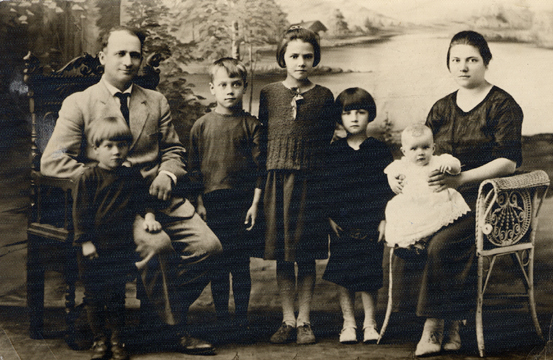
My mother later told me that her first child died because she was too young to know how to care for babies. Now that I think about it, I realize she must have been completely on her own in Coleman, a newcomer in a strange country, leaving the only family she had back in Winnipeg. She didn’t know the language and could not have known anybody to ask for advice or help.
At a very young age my mother had complete responsibility for their home, children, and money matters. She was a great cook, loved gardening, preserved fruit and vegetables every fall. She always made a barrel of sauerkraut for cabbage soup, pierogis, and other sauerkraut dishes. On weekends she baked bread and made extra bread dough for doughnuts, filling cartons that we soon emptied. She never baked less than three pies at a time.
There was never a limit to the amount of food we ate except when she baked cakes. She always tried to hide one for the following day, but we always found it. She would just laugh and say there wasn’t a good hiding place anywhere in the house.
Mother sewed and knitted for us when were very young. Whenever she found something broken in the house, she wanted to know who was responsible. We would put the blame on somebody who wasn’t around. She would laugh and say, “Why is it always the one who isn’t home?”
Once, when a neighbour’s husband left his wife and five children for another woman, I happened to see my mother carrying large pots of her home-made soup to the neighbour’s house. She probably did more for the neighbour than I was aware of.
My mother was always health conscious. If any of us were sick or in trouble she really worried. I believe she was overly concerned because of the loss of her first child.
Sam, my mother’s younger brother worked in a candy factory. He always had candy for us during his visits – a rare treat. One time, he gave us an old pair of his ice skates, so we (Olie nine, Paul seven, Bill three, and I five) all made our first attempts at skating. Each of us had to wear enough socks for the skates to fit. Sam, our special uncle, died of tuberculosis (TB) at the age of twenty-two.3
My father’s nephew Eugene (our cousin) died in 1929 in his early twenties of tuberculosis about a year after arriving from Poland. He worked on a farm soon after he came to Winnipeg. I remember my mother making many, many sandwiches for him to eat on the way to the farm. When he came home, he told my mother he threw them out the train window because he didn’t feel comfortable eating in front of all the strangers. Maybe they had no food and he spoke no English. He must have been a very shy man.
The overall mortality rate for TB in Canada in 1908 was reported by the Canadian Tuberculosis Association to be 165 per 100,000. During the 1930s we knew several people who died of the illness.
My mother worked cleaning homes. When we were older, she cleaned offices in the evenings at the Medical Arts Building. I believe she was happier there than working in private homes.
Thinking back, I don’t know how she managed it all. I only remember her saying she was tired on one occasion, while in the middle of preserving fruit late one evening. Our large kitchen table was covered with unfinished preserves with hours of work still ahead.
My mother was very active outside the home as well. She sang in a choir, acted in plays, occasionally gave eulogies at funerals and attended school to brush up on her English. She also hosted socials in our home to raise money for programs at the Ukrainian Hall4 or whatever was needed. Activities at the Hall were free to the public; people donated whatever they could. We children had lessons in Ukrainian dance, music (string and brass), memory improvement, gymnastics, and Indian clubs. I joined all the classes except the brass band and the choir.
Our parents took us to plays on Saturday nights and concerts on Sunday nights at the Ukrainian Hall. In the summertime we all went to picnics Sunday afternoons in East Kildonan5 that were arranged by the same organization. We always asked for five cents for an ice cream cone. There were so many of us that I don’t think my mother knew who asked her for seconds. We probably all did. I never saw her with an ice cream herself.

with Alice
My mother rented rooms for us in Winnipeg Beach for a week – our first holiday at a beach.6 We walked around town in the evenings. I watched people bowling for the first time and remember thinking that it was a game for the rich. My mother also took us all to a circus at the exhibition grounds near our home and to our first talking movie.7
Occasionally in winter I would crawl into bed with my mother and warm my ice-cold feet on her. She never stirred. She must have been exhausted. I’m sure we all took her for granted. I know I did.
She did have a temper, perhaps from work overload, but it never lasted long. Sometimes she would threaten to punish us and then forget, change her mind, or didn’t have time. Often, when I expected to be punished, it didn’t happen.
My friend Ollie Hillman and I were sixteen when we met three or four nice young men at Sunday concerts where we played in the mandolin orchestra. They sat in the balcony till the concert was over then waited for us outside the building where we talked and came to know them. We enjoyed their company and they eventually walked us home. We always chummed around in groups. They were really nice boys, well-behaved and fun to be with. Later some of their other friends joined us. On one of the walks we met my brother Paul. He stopped us and gave me the third degree: Who were they? When, where and how did we meet them? I believe he told my mother because she came looking for us the same evening with a long stick. Luckily, she missed us as it could have been embarrassing. Ollie and I often laugh about that night even to this day. I don’t think my mother thought it was funny then, but maybe she would now. She did like to laugh occasionally at some of the things we did.
My mother must have been at her wits end when my sister Olie and I were in our teens and busy trying to gain our independence. As far as I remember, my mother lost her temper with me twice and once that I know of with Olie.
After Olie and Oscar were married and baby Karl was born,8 she gave them a lovely, self-contained flat on the second floor of our house to live in. They moved to Toronto when Karl was about two or three years of age.
In later years, after my mother settled in Toronto, she found work in the needle trade. She was very happy at her job and enjoyed working in the company of other women.
My mother died of a heart attack at age 53 while holidaying at Wasaga Beach with my sister Millie, Millie’s husband Andy, their baby son Jim, and our sister Alice.
I carried a lot of guilt for the longest time because of my rebellious nature, and not understanding my mother’s plight in life.

Next Chapter: Flora Avenue
1 In 1892 Sokol was part of the region of Galicia, which straddled eastern Poland and western Ukraine. Galicia in turn was part of the Austro-Hungarian empire. In the 1921 census for the Bobowsky household, Anastazia’s nationality is given as Austrian and her “racial origin” as Ukrainian. The family spoke Ukrainian and affiliated with the Ukrainian community in Winnipeg. Urinow does not appear to exist today. It might have been a farm or an estate. Return
2 Martin and Anastazia were married on November 4, 1907, at St. Nicholas Ukrainian Catholic Church in Winnipeg, about two weeks before Anastazia’s 15th birthday. Martin was 26. Return
3 According to the Bobowsky family bible, Sam Kondratiuk died on August 12, 1924, a few weeks before his 22nd birthday. Return
4 A reference to the Ukrainian Labour Temple. See also Note 10. Return
5 East Kildonan is a community in north-east Winnipeg. Return
6 Winnipeg Beach is a resort town at the southern tip of Lake Winnipeg. Return
7 The first talking movie, The Jazz Singer, was released in October 1927. Return
8 Angela’s sister Olie (Olga Bobowsky) married Oscar Magid in 1932. Their son Karl Magid was born later that year. Return